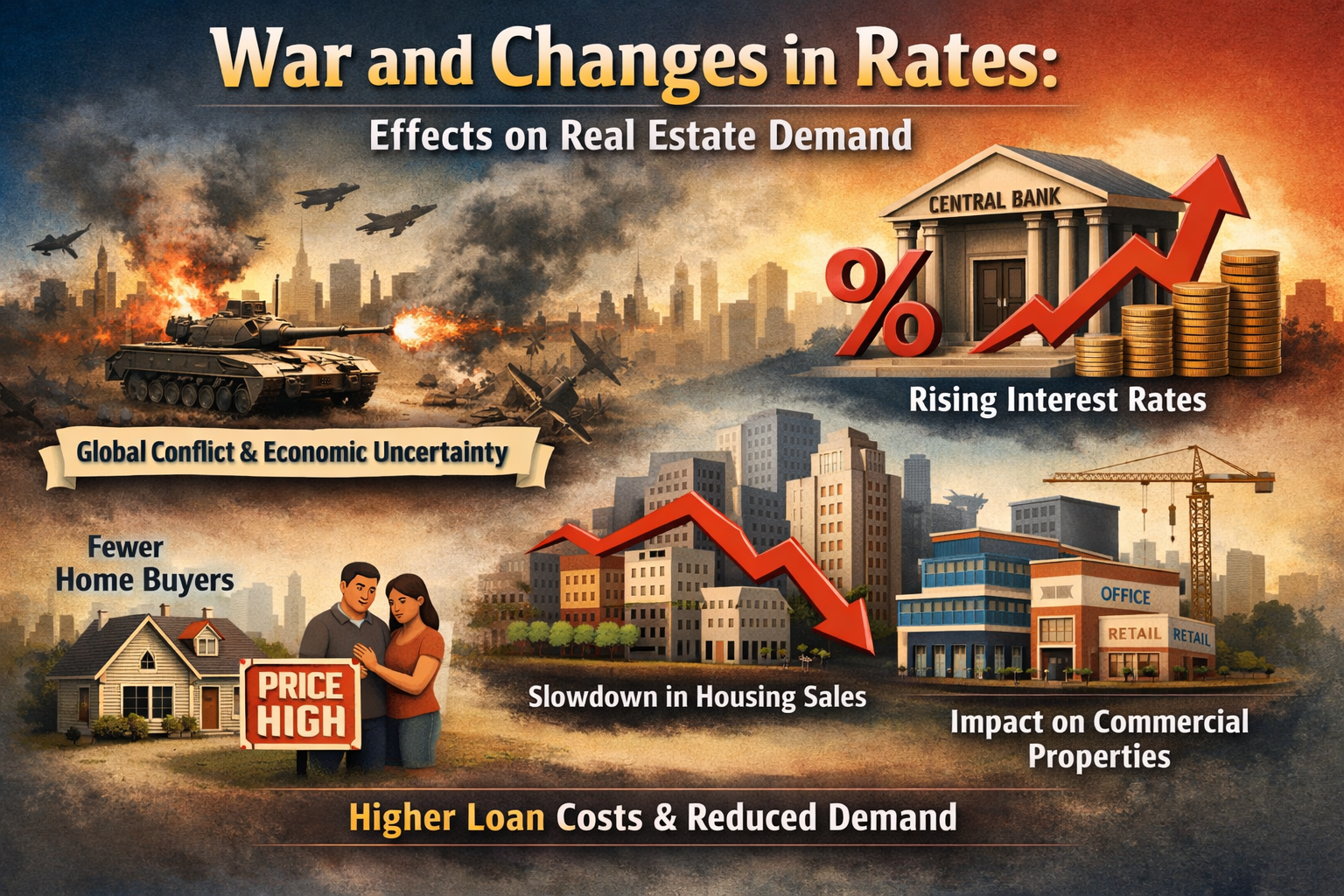
War and geopolitical instabilities tend to cause economic instability in the international markets. Governments can need more funding in defense where trade routes and supply chains are being disrupted. Such circumstances may lead to the price volatility of goods, particularly fuel and building materials. With the level of uncertainty rising, investors and homebuyers become averse to making huge financial investments like buying properties. Consequently, the real estate markets can generate temporary stagnations or demand curves.
The central banks usually tend to vary interest rates during the periods of war or the instability of the economy in order to regulate the inflation and stabilize the economy. Interest rates can go up, in case the inflation increases, because of increased energy or material expenses. It is a direct impact of the rates of interest on the cost of home loans where mortgages become expensive. When borrowing is expensive, most people put off their property buying or re-calculate their budgets.
An increase in the interest rates of home loans can have a great impact on the demand of residential property. Homeownership is also not affordable to many families because of increased monthly payments on loans. These changes are especially sensitive to first-time buyers of homes since they are highly reliant on financing. Consequently, the developers of property might observe a decrease in new bookings or the rate of sales in residential properties. The buyers, however, can also turn to smaller homes or properties in new areas which tend to have lower prices in other instances.
Global conflicts and interest rate changes may also have an impact on commercial real estate. When the economy is in a doubtful state, businesses tend to postpone their expansion plans. This has the potential of lowering office spaces, retail property demand and emergent commercial developments. Conversely, other industries like logistics, warehouses and other crucial retail might remain to expand as supply chains and necessary services are still in need of operational areas.
Real estate can however be a long-term investment though it is not certain. Other investors consider slowdowns in a market as a chance to get properties at a cheaper rate. Property demand could revive when the interest rates finally stabilize or when the rates decrease. During such times, investors who have financial resources in large proportions tend to exploit such moments to diversify their portfolios.
Real estate markets usually stabilize after some time despite the effects of wars and fluctuation of interest rates on the short run demand. Long-term demand is being driven by population growth, urbanization and housing needs. As the economic environment becomes better and the cost of borrowing funds are lowered, the buyers and investors slowly enter the market.
Finally, the temporary effects of wars and interest rates alterations on real estate demand would be their effects on the cost of borrowing, investor confidence, and economic stability. Nonetheless, real estate industry tends to implement the changes and still remains an important component of long-term investment policies.

