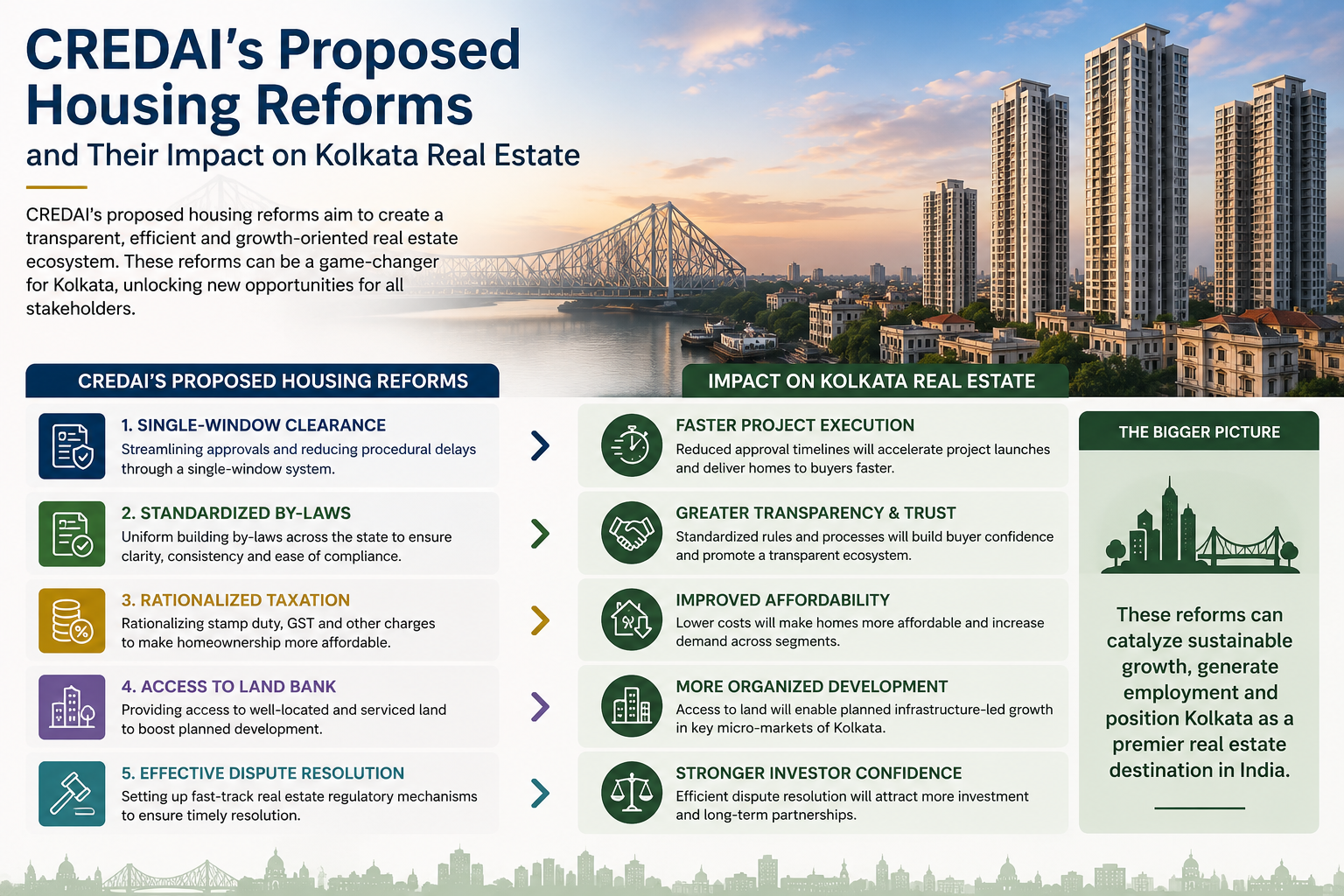
With the ongoing development of infrastructure, the expansion of metros, and the rising demand for housing, Kolkata’s real estate market is poised for a new era of growth. But industry participants feel policy changes are needed to tap the market potential. The Confederation of Real Estate Developers’ Associations of India (CREDAI) has recently put forth a set of housing and development reforms that would serve as a boost for investments, increase project approvals and encourage big housing projects in West Bengal’s townships.
These proposed changes have the potential to greatly impact the real estate market in Kolkata, making housing projects more profitable, appealing to private investment and providing new opportunities for home buyers. These, if adopted, can contribute to better solutions of persistent problems and contribute to sustainable urban development.
One of the biggest sectors for economic growth and employment generation is real estate. Despite the housing demand in Kolkata and its neighboring areas, the developers are often facing issues in project approvals, providing infrastructure support, regulatory requirements, and development expenses.
CREDAI feels that by making regulations more streamlined and providing policies which are investor friendly, housing development can be hastened. Simplified procedures would encourage developers to launch new projects, improve housing supply, and help the state’s overall urban development objectives, industry leaders argue.
The planned changes aim to make the development process more efficient and predictable for developers and homebuyers.
A key recommendation in CREDAI is to encourage townships integrated projects. Townships are gigantic projects that integrate residential units together with schools, health clinics, retail centres, recreational areas and other services.
Self-contained communities are gaining in popularity with today’s home buyers who value convenience, security and quality of life. Already, the successful township development in New Town, Rajarhat and along EM Bypass corridor have been achieved in the city of Kolkata.
The government can promote township development using policy support and incentives to build well planned urban communities and alleviate the pressure of the old city areas, while enhancing the overall living standard.
The long time it takes to approve real estate projects is one of the major issues developers have. The time it takes to submit and receive permits and clearances can also drive up project expenses and timeframe.
CREDAI had called for a speedy and hassle-free approval process. The streamlined process would enable the developers to start construction earlier, minimize administrative work and enhance project efficiency.
Faster approvals, in the eyes of the homebuyer, may mean the project will be available sooner and the total cost may be reduced, since the developer will not have as many delays or financing costs to contend with.
The affordable housing segment is still a significant part of the real estate market in Kolkata. Demand for premium housing has been on the increase in recent years, but there remains a decent demand from middle income and first-time buyers.
CREDAI has highlighted the importance of supporting policies that encourage the development of affordable homes by incentivizing them, lowering fees and improving financing options. These measures may incentivize developers to start more initiatives directed to the budget-conscious buyers.
An increase in affordable housing would not only assist families in becoming homeowners but would be a factor in helping to balance housing development around the city.
Infrastructure is key to real estate development. The demand and value of property is greatly affected by roads, public transport, water supply, drainage and power infrastructure.
CREDAI has highlighted the need to enhance the infrastructure in the emerging development corridors in and around Kolkata. Further government investment is required in certain areas such as New Town, Rajarhat, Joka, Southern Bypass, Howrah and parts of North Kolkata.
Improved infrastructure will make these sites more appealing to residents and investors, and promote future residential and commercial development.
Investors confidence can be directly affected by policy reform. The real estate sector is more likely to be opened up to domestic and institutional investment if a regulatory framework is transparent and efficient.
With CREDAI’s recommendations put into effect, Kolkata might be even more appealing real estate investment destination. More capital coming in would enable the development of residential, commercial and mixed-use projects as well as employment in the construction, infrastructure and related sectors.
An improved real estate economy also supports overall economic development by stimulating the demand for materials, services and labour.
Many of the proposed reforms are targeted at development and investment but home buyers will also benefit hugely.
A more efficient approval system can help deliver projects more quickly and lessen uncertainty. Housing supply can create a larger choice of housing for buyers in various price ranges. Improved infrastructure can enhance connectivity, accessibility and overall quality of life.
Also, the development of integrated townships can give residents modern amenities, green spaces, education, health care facilities, and recreational facilities within their communities.
These reforms will probably have a neutral effect on property values. In rapidly growing regions, gradual increases in price should be expected due to infrastructure improvements and increased demand. Meanwhile, a more robust supply of housing could help tamp down runaway price growth.
This makes the area an appealing investment territory as there is the possibility of long-term growth and it’s easily accessible to many potential buyers.
New infrastructure and township development projects are projected to be even stronger in the years ahead in areas where such projects are anticipated.
The proposed reforms have many positive impacts, but they will need to be implemented in a coordinated fashion among government agencies, urban planners, developers and financial institutions.
Authorities need to ensure sustainable planning, environmental protection, and capacity of infrastructure in the face of the rapid development. To maximise the benefits of these reforms, there will need to be a balance between growth and long-term urban sustainability.
With proper implementation, the proposed change will see to how well the real estate industry will benefit from the change in the real world.
The housing reforms proposed by CREDAI could significantly impact the real estate landscape of Kolkata by promoting the growth of townships, easing approval processes, promoting affordable housing, and fostering increased investment. The measures may have the potential to establish a more fluid and productive housing system, which is good for all stakeholders—developers, investors, and homebuyers alike.
Policy reforms will be a key determinant of future growth as the city continues to grow and modernise. By successfully implementing CREDAI’s recommendations, new opportunities can be created, the housing market can be strengthened and long-term sustainable urban development can be ensured in the city.

