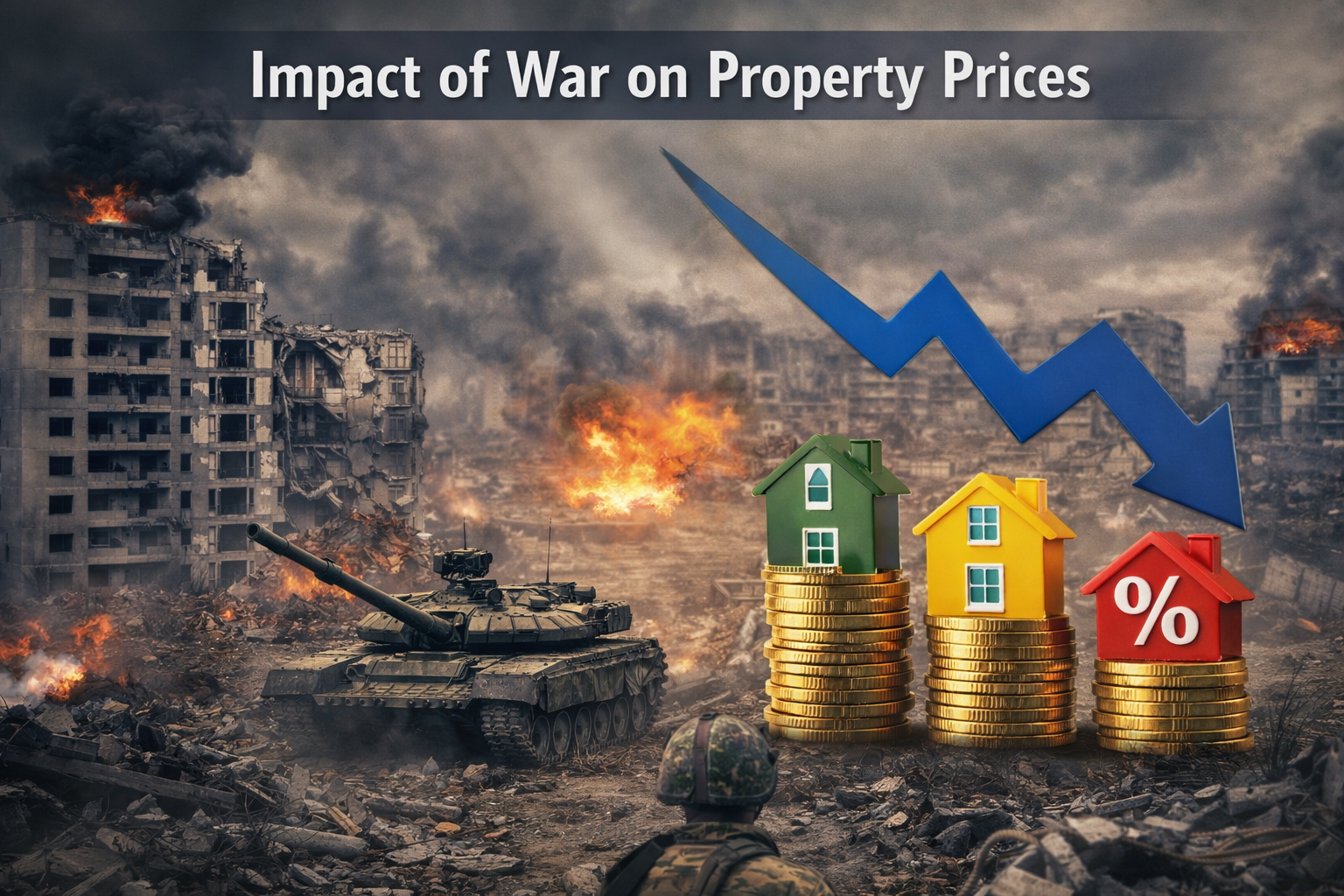
Geopolitical tensions and war-like situations are very far reaching in global economies and real estate sector is not an exception. Housing prices, residential and commercial, are usually very sensitive to uncertainty, inflation and investor sentiment. The real estate markets are recording mixed tendencies in 2026, as the global instability grows with other countries, whether in short-term decline or in long-term stability.
At the first stage of a war or geopolitical conflict, the real estate markets slow down. The economic uncertainty, job security issues, and unstable financial markets make buyers use the wait-and-watch strategy.
This reluctance usually contributes to decreased demand, particularly in the high-end segments like luxury property and office space. New launches can be postponed by developers, transactions can temporarily decelerate and property prices are slightly under pressure.
Disruption of global supply chains can be regarded as one of the most important effects of war. Trade restrictions and increased transportation costs tend to make vital construction materials like steel, cement, fuel and foreign-made fixtures more expensive.
The developers experience margin pressure as the input costs rise and this may translate to a rise in the prices of the property when it is in under-construction. Developers might not lower prices drastically even when demand declines because of these high costs and this gives a complex pricing environment.
The volatility of the metro cities like Mumbai, Delhi NCR, and Bengaluru tends to be short term in times of geopolitical tensions. Demand can be weakened in the short run and especially in commercial real estate where companies put off expansion decisions.
Nevertheless, these cities are likely to have a quicker recovery because of good economic fundamentals, infrastructure, and job prospects. As a matter of fact, well-located properties in metros tend to remain valuable even in uncertain times, thus remaining rather stable investments.
The situation is usually different with Tier-2 and Tier-3 cities. The uncertainty in times of war makes buyers seek cheaper and less risky investment opportunities, and this has given rise to interest in the emerging markets.
These cities are appealing due to lower prices of property, low population density, and the infrastructure is being enhanced. Consequently, stagnation can be seen in the metro markets, whereas smaller cities can have their demand steadily growing or even increasing, which contributes to the increase in property prices.
The other observed trend is the change in preference of buyers to ready-to-move-in houses. It is seen that under-construction projects are risky in such uncertain times as they may result in delays and cost increase.
This demand of finished properties can push their prices higher whereas the under-construction properties might not appreciate at a rapid rate unless supported by immensely reputed developers.
The commercial real estate segment is usually more difficult in war times. Companies can delay leasing plans, lower office space demands, or implement adaptive working systems.
The problem of reduced consumer spending can also affect retail spaces. But other areas of the economy, including warehousing and logistics, can likely fare better because of the changes to supply chains and the need to utilize storage and distribution facilities more often.
Although short term fluctuations prevail, real estate is still being considered a fairly safe and tangible asset. With time, property prices are bound to pick up and increase, with the help of urbanization, population increase and formation of infrastructure.
The fact that investors tend to invest in real estate in times of a long-term geopolitical crisis to protect themselves against inflation and currency changes supports its use as a tool to preserve wealth.
War and its effects on property prices are multi-dimensional. Although the short-term uncertainty can reduce demand and cause volatility, increasing costs of construction and changing buyer preferences can justify prices in select segments. Metro cities are the place of stability and emerging markets are the place of growth.
These dynamics can be understood so that buyers and investors can make informed decisions even in hard times of global situations.

